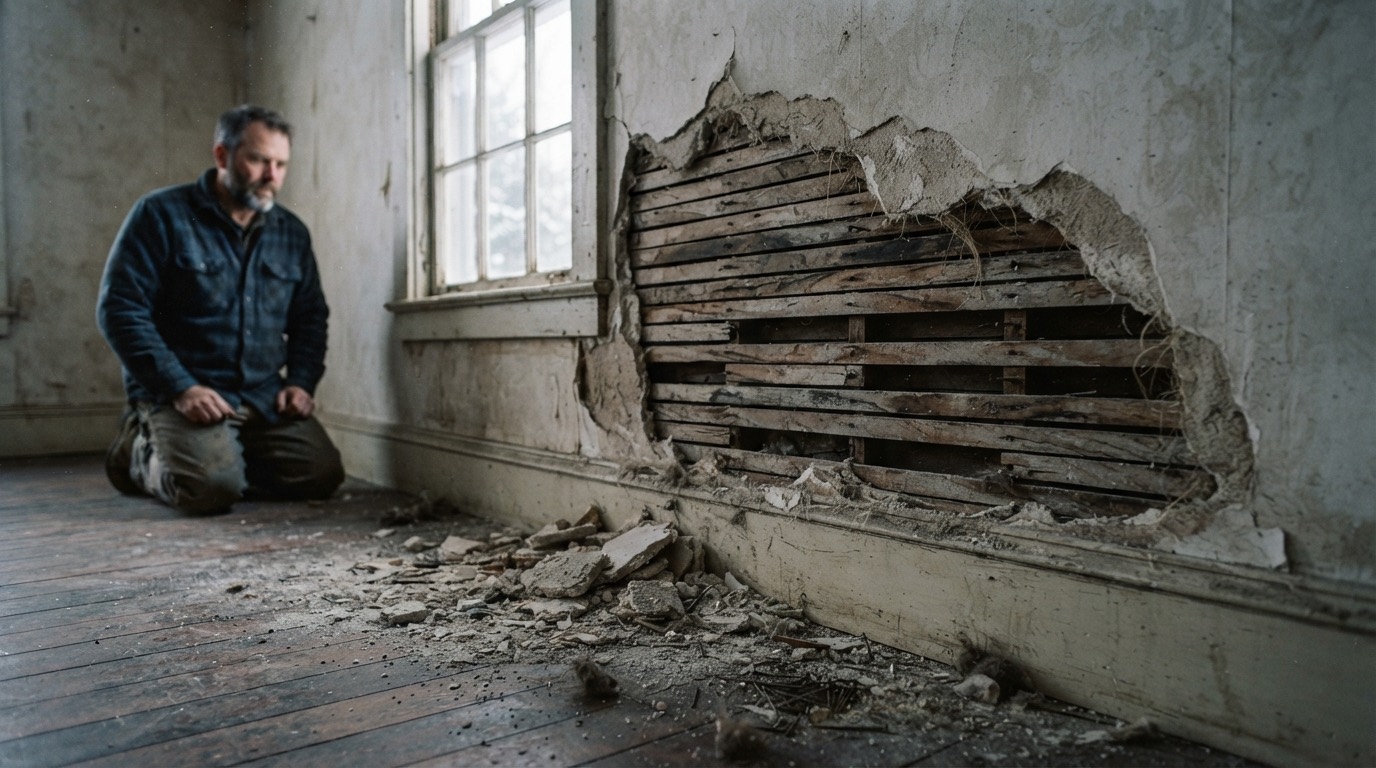
Crumbling plaster and exposed lath in Manchester, NH
The mill-era walls behind your paint
If your house went up before about 1950 — and an enormous amount of Manchester did, thanks to the pace the Amoskeag mills built at — the walls are almost certainly lime plaster over thin wooden lath strips, sometimes with horsehair mixed in as a binder. It is a better wall than anything built since: harder, quieter, and considerably more fire-resistant. It also fails in ways that modern drywall does not, and a tradesman who only knows board will make a mess of it.
How to tell what you have
Knock on it. Plaster returns a hard, dead sound with barely any give; drywall sounds hollow and drummy between the studs. Push a pin somewhere hidden: it goes into drywall with light pressure and stops dead against plaster. Look at an electrical box — plaster walls are usually noticeably thicker at the cut edge. There is a fuller version of this on plaster or drywall.
What actually goes wrong
Plaster does not really crack from the surface inward. What fails is the grip: the plaster that oozed between the lath strips and hardened into hooks is what holds the whole wall up, and a century of vibration, settlement and the occasional roof leak breaks those hooks. The plaster then sits loose against the lath, sounds hollow when tapped, and moves slightly under hand pressure. Surface cracks are a symptom of that, not the disease.
Saving it where it is sound
Plaster that is intact but detached can be pulled back against the lath and held there mechanically with washers driven through into the lath or the framing behind it, often with adhesive injected into the void first. The heads are then buried and the area skimmed. This preserves the original wall, keeps the room quiet, and typically costs less than tearing out and reboarding.
When board is the right answer
Where the plaster is genuinely crumbling to powder, where a large area has released, or where the lath itself has rotted or been cut about by a century of pipes and wiring, replacement is the sensible call. New board goes in packed out to sit flush with the plaster around it, because plaster runs appreciably thicker and a straight swap leaves a visible trough at the join.
The joint between old and new
This is where the craft is. Two materials of different thickness that expand at different rates meet in one plane, and an ordinary taped seam across that boundary will telegraph within a season. It wants a mesh reinforcement bedded in a setting-type compound rather than ordinary air-drying mud, and a wide, gradual build-up. Done properly you cannot find the transition; done casually you can see exactly where the old house stops.
Textured and sand-finished plaster
A lot of the older stock here has a sand float or a light swirl worked into the finish coat, which a flat modern patch will never match. Those finishes are reproducible with a sanded compound and hand tools of the same shape the original tradesman worked with, and matching them is part of the job rather than an extra we mention afterwards.
Often turns up alongside
People dealing with Crumbling plaster and exposed lath usually also ask about our a hole in the wall service, professional cracks over doors and windows and a brown stain on the ceiling services — call and we'll tell you which one your job needs.
Towns we cover
We take this work across the Merrimack Valley, including drywall repair in Bedford, Goffstown drywall repair calls, serving Hooksett, drywall repair for Londonderry property owners, Derry, drywall repair in Auburn, Candia drywall repair calls, serving Merrimack, drywall repair for Litchfield property owners, Bow, drywall repair in Concord and Nashua drywall repair calls, and the surrounding communities.
Send a photo of it
A photo of the damage is usually enough for a number the same day.
📞 Tap to Call — Free Estimate 603-309-9597The line is answered 24/7 · on site weekdays 7:30 to 5:30, Saturday mornings by arrangement