How to tell whether your walls are plaster or drywall
This determines almost everything about a wall repair: the method, the material, the time and the price. It also decides whether a given tradesman is the right one to call. Four tests, none of which requires tools you do not own, and you will know in about two minutes.
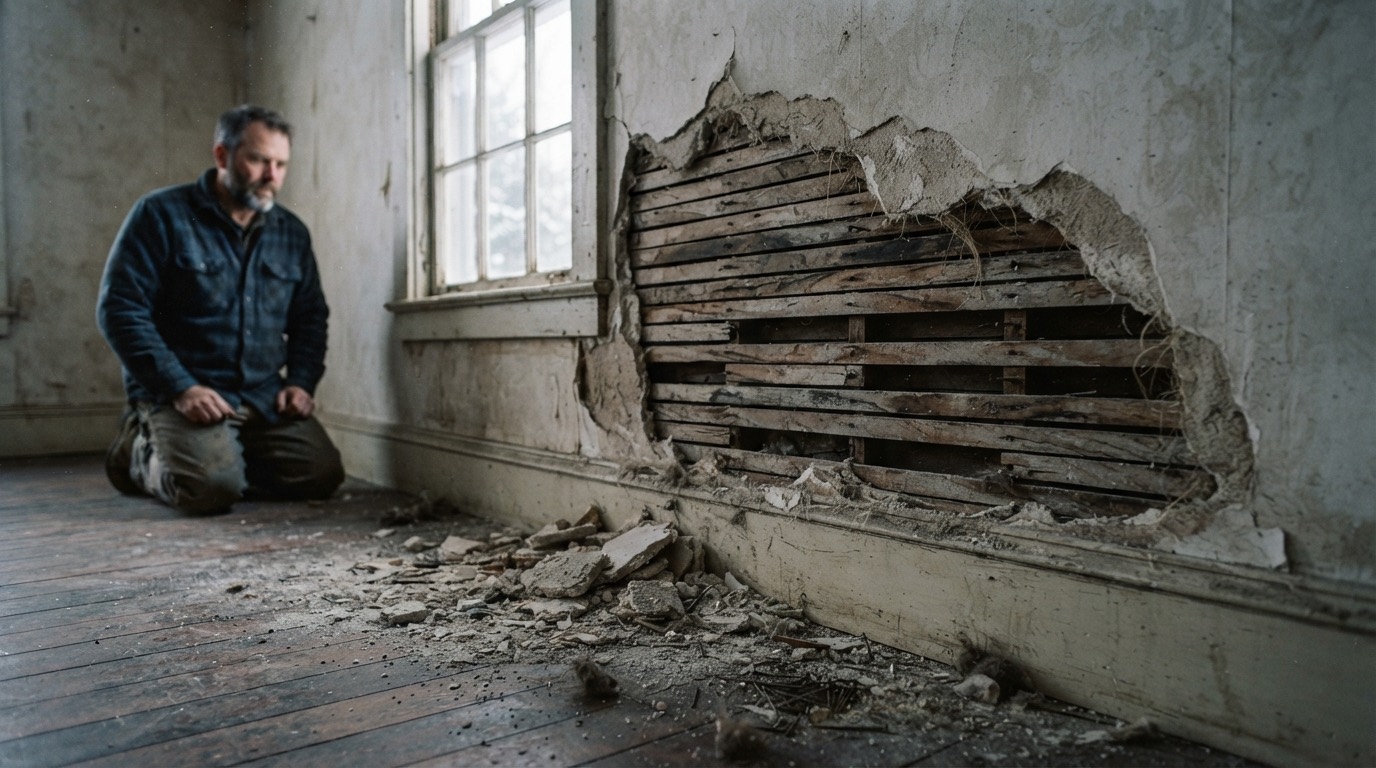
One: knock on it
Rap the wall with a knuckle in a few places between where you think the studs are. Drywall sounds hollow and slightly drummy, with an obvious change in tone when you cross a stud. Plaster over lath sounds hard, flat and dead almost everywhere, because behind it is a continuous surface of wooden strips rather than an air gap. If part of a plaster wall does sound hollow, that is worth knowing for a different reason: it may have come away from its lath.
Two: push a pin into it
Somewhere hidden — inside a closet, behind a door — press a drawing pin in with your thumb. It sinks into drywall with light pressure. Against plaster it stops dead and will not go in at all without a hammer. This is the quickest reliable test.
Three: look at a cut edge
Take the cover plate off a light switch or an outlet and look at the material at the edge of the opening. Drywall shows a white gypsum core with obvious paper facing on both sides, and is usually half an inch thick. Plaster shows a solid grey or white mass, no paper, and is commonly three quarters of an inch or more once you include the lath behind it. You may be able to see the wooden strips themselves.
Four: consider the age of the house
Anything in Manchester built before about 1945 is plaster unless somebody has since gutted it. Anything after about 1955 is drywall. The decade in between is a coin toss, and plenty of houses are both — plaster in the original rooms, board in an addition, and occasionally board screwed straight over failing plaster by a previous owner.
Why it changes the repair
Plaster is patched with plaster or with board packed out to match its greater thickness; the join between the two materials needs a reinforced, gradual transition or it telegraphs within a season. Loose plaster is re-secured mechanically before anything is applied to the surface. Sand and swirl finishes are reproduced rather than skimmed flat. A tradesman who only works in board will patch a plaster wall with the wrong material at the wrong thickness, and you will see it. More detail on crumbling plaster.
And what it does to the price
Plaster work generally costs more per square foot than board because it is slower and needs a different skill set — but re-securing sound plaster is usually cheaper than the tear-out-and-reboard that gets proposed instead. Figures for both are on what it costs.
Send a photo and we will price it
A photo of the damage is usually enough for a number the same day.
📞 Tap to Call — Free Estimate 603-309-9597The line is answered 24/7 · on site weekdays 7:30 to 5:30, Saturday mornings by arrangement